
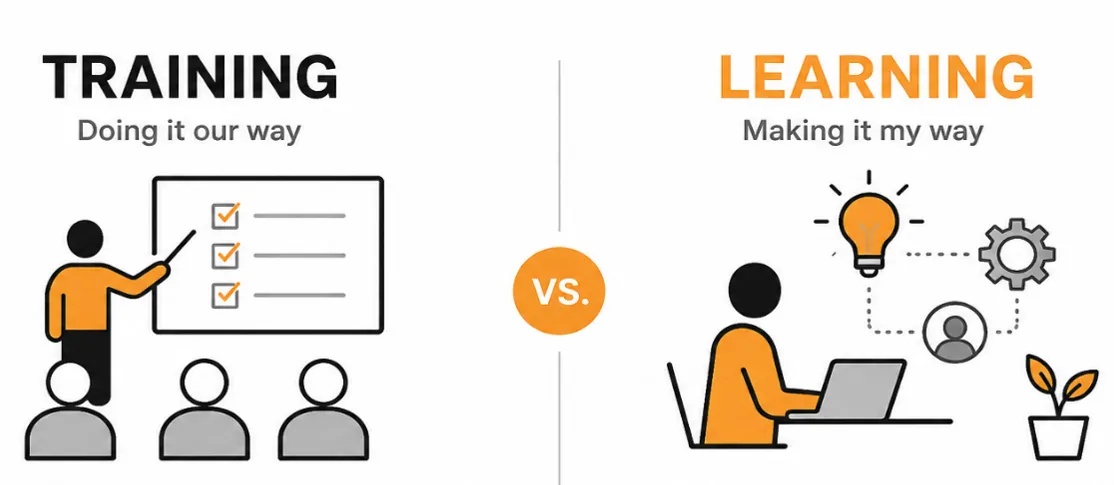
For decades, organizations have used the word training as the catch-all term for helping employees develop new skills. We train people on new software. We train managers. We provide safety training. Sales training. Leadership training. Compliance training. Product training. The term is so deeply embedded in workplace language that we rarely stop to question it.
But perhaps we should. Because the workplace we are preparing people for today is very different from the workplace where traditional training models were created. And increasingly, the difference between training someone and helping someone learn matters.
This is more than semantics. Training and learning represent two different ways of thinking about workforce development. One is primarily concerned with transferring information and producing a desired behaviour. The other is concerned with developing understanding, capability, judgement and the confidence to apply knowledge in situations that may not look exactly like the examples provided.
Both have value. But in an environment being reshaped by artificial intelligence, automation and rapidly changing technology, organizations need considerably more of the second.
Training was built for consistency
Traditional workplace training developed for a very practical reason: organizations needed people to perform tasks correctly and consistently. There is nothing inherently wrong with that.
If someone operates a forklift, there are procedures they need to follow. If an employee handles hazardous materials, certain behaviours cannot be left to personal interpretation. When a new piece of equipment is installed, people need to understand how it works. In these situations, training makes perfect sense. There is an expected way to perform the task.
Training therefore tends to follow a fairly straightforward model: here is the information, here is the process, here is how we want you to do it, now demonstrate that you can do it.
For stable, repeatable work, this model can be extremely effective. The problem occurs when we begin applying the same philosophy to work that is no longer stable or repeatable. And that describes a growing percentage of modern knowledge work.
Learning starts with a different question
Instead of asking how do we get people to perform this task correctly, learning asks: how do we help people build the capability to understand, adapt and make good decisions?
That difference becomes important when there may be several legitimate ways to accomplish something. Consider artificial intelligence. We can certainly train an employee how to use ChatGPT, Copilot or another AI tool. We can show them where to click, teach them how to enter a prompt, explain how to upload a document or summarize a meeting.
But that is only a small part of becoming capable with AI. The real value comes when someone begins looking at their own work and thinking: could AI help me with this? What information should I provide? How should I structure the request? Is this output actually correct? What should I change? Is this an appropriate use of AI at all?
No instructor can provide a script covering every one of those situations. The employee must learn how to think. That is where training begins to give way to learning.
Training often has an answer. Learning builds judgement.
Training traditionally assumes that someone already knows the correct answer. The instructor knows it. The procedure contains it. The course teaches it. The employee learns to reproduce it.
Learning becomes more important when the answer depends on context. Imagine two employees using AI to prepare a customer proposal. One may use AI primarily for research. Another might use it to create an outline. Another may draft portions of the proposal with AI and then heavily revise them. Someone else may use AI as a critical reviewer after writing the proposal themselves.
All four approaches might be entirely appropriate. The objective therefore is not necessarily to teach everyone the correct AI workflow. There may not be one. The objective is to help employees understand the technology well enough that they can develop an effective workflow of their own while operating within the organization's expectations around privacy, security, accuracy and responsible use.
That requires judgement. And judgement cannot simply be trained into someone through a slide deck and a quiz. It develops through learning, experimentation, feedback and experience.
The difference is ownership
Training is often something that is done to an employee. Learning is something the employee increasingly owns.
An organization schedules a training session. Employees attend. Someone presents information. Perhaps there is an exercise. Employees complete an assessment. The learning management system records a completion. Everyone moves on. From the organization's perspective, the box has been checked.
But completion is not the same thing as capability. An employee can complete a course, pass the quiz and remember almost nothing two weeks later. The organization delivered training. Very little learning occurred.
Learning requires engagement. The individual must connect new information to something they already know, use it in a meaningful context, test it, make mistakes, receive feedback and use it again. The goal is not simply remembering the material. The goal is being able to use it.
From knowledge transfer to capability building
Organizations often approach reskilling as another training initiative. A new technology arrives. Employees need skills. Courses are purchased. People attend workshops. Completion rates are measured.
But the real question should not be how many employees completed the training. It should be: what can our workforce do now that it could not do before?
That is a very different measurement. It shifts the emphasis from activity to capability. Someone attending three AI workshops tells us almost nothing about whether they can use AI effectively. Someone completing ten hours of spreadsheet training tells us surprisingly little about whether they can analyze business information. Someone taking leadership training does not automatically become a better leader.
Organizations should care less about the volume of content delivered and more about the capability that develops afterward.
Learning must be more adaptive
Traditional training also tends to assume that people begin from roughly the same place. In reality, they rarely do. Put twenty employees into an AI workshop today and you may have someone who has never opened an AI tool sitting beside someone who uses several of them every day.
Delivering identical content to both people is inefficient. One will be overwhelmed. The other will be bored. Neither will receive exactly what they need.
A learning approach recognizes that capability develops differently for different people. Employees have different starting points, different jobs, different levels of digital confidence, different learning preferences, different motivations and different opportunities to apply what they learn.
Technology now gives organizations the ability to create much more adaptive learning experiences. Instead of forcing every employee through the same curriculum, organizations can increasingly assess current capability and provide learning appropriate to the individual. The question shifts from what course should everyone take, to what does this person need to learn next. That may prove to be one of the most important changes in workforce development over the next decade.
AI makes the difference even more important
Artificial intelligence adds another dimension because the technology itself changes so quickly. Historically, organizations could train someone on a software platform and expect much of that knowledge to remain relevant for years. AI does not work that way. Capabilities change. Tools change. Interfaces change. Models improve. New ways of working emerge.
A perfectly designed AI training course can begin becoming outdated almost immediately. That does not mean organizations should stop teaching AI skills. It means they should focus less on teaching employees exactly how today's tool works and more on helping them develop the ability to continually learn how to work with AI.
Curiosity becomes a workforce capability. Experimentation becomes a workforce capability. Critical thinking becomes a workforce capability. Knowing how to ask better questions becomes a workforce capability. Recognizing when an AI-generated answer is questionable becomes a workforce capability. These abilities travel with the employee even when the technology changes. That is far more valuable than memorizing which button to press.
Training still has a place
None of this means organizations should eliminate training. Safety procedures should be trained. Compliance requirements should be trained. Cybersecurity fundamentals should be trained. Certain processes need consistency. Certain behaviours need clear expectations. Certain knowledge simply needs to be communicated.
The mistake is assuming that all workforce development should follow the training model. Perhaps the better distinction is this: train people where consistency matters, and help people learn where adaptability matters. That line will differ between organizations and roles, but it provides a useful starting point. And increasingly, adaptability matters almost everywhere.
The leader's role changes too
In a traditional training environment, leaders send employees to courses. In a learning organization, leaders create an environment where learning continues after the course ends. They encourage experimentation. They allow employees to try new tools. They make it acceptable to say, I do not know how to do this yet. They encourage people to share what they discover. They create opportunities to apply new capabilities to real business problems.
Perhaps most importantly, they recognize that learning requires some degree of freedom. If we teach people new capabilities but insist that every task continue to be performed exactly the way it has always been performed, we should not be surprised when very little changes. People need permission to use what they learn.
The goal is not conformity. It is capability.
For much of the industrial era, organizations became successful by creating repeatable processes and teaching people to follow them. That philosophy produced enormous gains in productivity and quality. But we are moving into an environment where many organizations need something additional.
They need employees who can navigate ambiguity. People who can combine technology with experience. People who can identify better ways of working. People who can learn new tools without waiting for someone to create a course. People who can make good decisions when there is not a procedure covering the situation in front of them.
In other words, organizations increasingly need a workforce that knows how to learn. That may ultimately be the biggest difference between training and learning. Training prepares someone to perform a task. Learning prepares someone for what comes next. And in a world where nobody knows exactly what comes next, that distinction matters.
Insights on building a digital and AI-capable workforce.
Submit your email for practical research, frameworks and ideas on workforce capability.